Summary
For most of its history ship maintenance was judged on reliability and safety. Since the IMO's carbon intensity measures took effect in 2023, it is also judged on efficiency. A fouled hull, a rough propeller or an engine out of tune burns more fuel for the same voyage, and that now shows up in the ship's operational carbon intensity rating as well as its fuel bill.
This paper explains how maintenance affects efficiency, how to measure hull and propeller performance properly, what the biofouling guidelines require, and how to use the Planned Maintenance System (PMS) to trigger efficiency maintenance at the right time rather than on a fixed calendar.
1. The regulatory context
Three sets of IMO measures under MARPOL Annex VI now link operation and maintenance to carbon intensity:
- EEXI (Energy Efficiency Existing Ship Index): a one-time technical requirement on the ship's design efficiency, often met by engine power limitation.
- CII (Carbon Intensity Indicator): an annual operational rating, from A (best) to E, for ships of 5,000 gross tonnage and above of the covered types, based on fuel consumed per unit of transport work. The required level tightens year by year. A ship rated D for three consecutive years, or E in a single year, must develop a corrective action plan.
- SEEMP Part III: the ship's energy efficiency management plan must set out how the required CII will be achieved, and the plan is subject to verification.
Maintenance is one of the few levers fully under the operator's control. Speed, routing and cargo are constrained by commercial reality; the condition of hull, propeller and machinery is not.
2. Where maintenance affects fuel consumption
| Area | Mechanism | Maintenance lever |
|---|---|---|
| Hull | Fouling and coating breakdown increase frictional resistance | Coating selection and renewal, hull inspection and cleaning |
| Propeller | Fouling and surface roughness reduce propeller efficiency | Propeller polishing, inspection for damage |
| Main engine | Worn injection equipment, poor combustion, fouled turbochargers and coolers increase specific fuel consumption | Condition-based engine maintenance, performance-guided tuning |
| Auxiliary systems | Generators, boilers, pumps and compressors running inefficiently or unnecessarily | Load management, maintenance of heat exchangers and controls |
| Energy-saving devices | Ducts, fins and other devices damaged or fouled | Inspection and cleaning with the hull |
Hull and propeller condition is usually the largest and most variable of these, because fouling develops continuously between cleanings and depends heavily on trading area, water temperature, idle periods and coating.
3. Measuring hull and propeller performance: ISO 19030
Before a cleaning or coating decision can be made on evidence, the change in performance has to be measured. ISO 19030 (Ships and marine technology — Measurement of changes in hull and propeller performance) provides a standard method.
The principle is to compare the ship's actual speed with the speed expected for the same power, draught and trim under reference conditions. The difference, the speed loss, isolates the effect of hull and propeller condition from weather, loading and operation, provided the data is filtered and corrected appropriately.
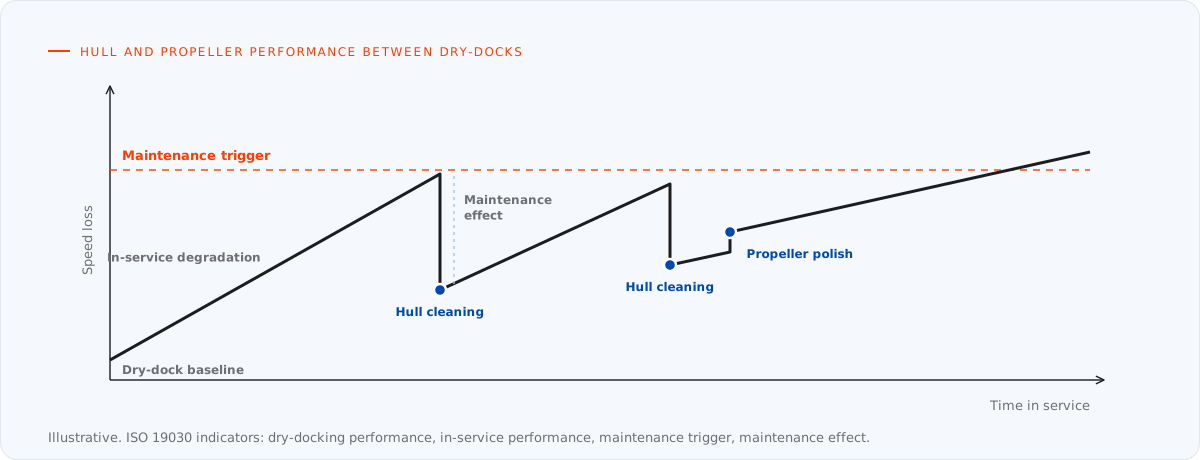
Figure 1. Performance-triggered maintenance: speed loss rises between interventions and is restored by cleaning and polishing (illustrative).
ISO 19030 defines performance indicators that map directly onto maintenance decisions:
| Indicator | Question it answers |
|---|---|
| Dry-docking performance | How well did the last dry-dock, including the coating, restore performance? |
| In-service performance | How much has performance degraded since the dock? |
| Maintenance trigger | Has degradation reached the point where cleaning or polishing is worth doing? |
| Maintenance effect | How much did a cleaning or polishing event actually recover? |
Data quality matters. The standard favours high-frequency data logged automatically from shaft power, speed through water, draught and other sensors over manual noon reports, which are too sparse and too noisy to separate small changes from weather effects. Speed-through-water logs in particular need regular verification.
4. Biofouling management
Biofouling is both an efficiency and an environmental issue: fouling organisms carried on hulls can introduce invasive species to new regions. The IMO's 2023 Guidelines for the control and management of ships' biofouling (resolution MEPC.378(80)) set out good practice, including:
- a Biofouling Management Plan specific to the ship;
- a Biofouling Record Book recording inspections, cleanings and coating work;
- attention to niche areas such as sea chests, thrusters, propeller shafts and gratings, where fouling accumulates first;
- risk assessment of operating profile, including long idle periods, which sharply increase fouling;
- in-water inspection and cleaning practices that avoid damaging the coating and, where required, capture removed material.
Some port states have their own mandatory biofouling requirements, with New Zealand and Australia among the best known, and anti-fouling coatings must comply with the IMO AFS Convention on harmful anti-fouling systems.
For the PMS, this means hull, niche-area and coating inspections, cleaning events and their findings belong in the maintenance record, linked to the equipment and the Biofouling Record Book, rather than in separate files.
5. Performance-triggered maintenance
The traditional approach is to clean the hull or polish the propeller at fixed intervals or when convenient. A performance-based approach uses the ISO 19030 maintenance trigger instead:
- Establish the baseline after dry-dock, from the dry-docking performance indicator.
- Monitor in-service performance continuously.
- Trigger an action when the speed loss passes a threshold where the fuel saved by cleaning or polishing over the following months exceeds the cost and risk of the intervention, including coating damage and port restrictions.
- Measure the maintenance effect after each intervention, and adjust the threshold with experience.
Propeller polishing is typically cheaper and faster than hull cleaning and can be scheduled more often. Hull cleaning needs more care: the coating type, the cleaning method, local regulations and the risk of coating damage all affect the decision. Idle periods in warm water are a common trigger for an inspection regardless of the trend.
The same logic applies to the engine. Performance monitoring of cylinder pressures, exhaust temperatures, turbocharger efficiency and specific fuel consumption (see paper 04) shows when injection equipment, turbocharger cleaning or cooler maintenance is due on evidence rather than on hours alone.
6. What the PMS must connect
Efficiency maintenance spans systems that are often separate: performance monitoring, the PMS, the biofouling records and the energy management plan. The PMS should hold:
- Hull, propeller and niche-area inspection jobs, with findings, fouling ratings and photographs;
- Cleaning and polishing events as maintenance records, with date, location, method and contractor;
- Coating history: system applied at each dock, areas and condition;
- Links to performance data, so the speed loss before and after each event is visible next to the job;
- Engine performance measurements as structured data against the equipment;
- Triggers that raise jobs from performance thresholds, not only from the calendar.
With these links in place, the cost of a cleaning and the fuel it saved can be compared directly, and the CII impact of maintenance becomes measurable.
7. Building the business case
Efficiency maintenance competes for budget like any other work. A simple, defensible case compares:
- the fuel saved between interventions, estimated from the performance trend and the fuel price;
- the carbon intensity improvement, and its value in avoiding a poor CII rating and the corrective action that follows;
- the cost of the intervention, including diver or robot cleaning, port restrictions, off-hire time and coating risk.
Measured maintenance effects from previous interventions make the case far stronger than generic estimates. That is another reason to record every cleaning and its result in the PMS.
Conclusion
Under CII, maintenance is no longer only about keeping a ship running; it is about keeping it efficient. Measuring hull and propeller performance to a recognised standard, managing biofouling systematically, triggering cleaning and engine work on evidence, and recording every event and its effect in the PMS turns maintenance into one of the most reliable tools a ship manager has to protect both the fuel budget and the carbon rating.
References and further reading
- MARPOL Annex VI, regulations on EEXI, operational carbon intensity (CII) and SEEMP, as amended.
- ISO 19030, Ships and marine technology — Measurement of changes in hull and propeller performance.
- International Maritime Organization, resolution MEPC.378(80), 2023 Guidelines for the control and management of ships' biofouling to minimize the transfer of invasive aquatic species.
- International Convention on the Control of Harmful Anti-fouling Systems on Ships (AFS Convention).
- Companion papers: 04 RCM and CBM, 08 Dry-dock planning and 07 The future of PMS.
Connecting maintenance and efficiency? We structure PMS data so that hull, propeller and engine maintenance can be linked to performance and carbon intensity. See our Planned Maintenance System services.