Summary
The interval attached to a maintenance job looks like a single number in a database. In practice it is where three demands meet: what the equipment maker recommends, what the classification society requires, and what the crew can realistically deliver. When intervals are set carelessly, the schedule fills with false overdue items, real ones get lost among them, and the records stop telling a consistent story.
This paper explains how to set and manage periodicities in a Planned Maintenance System (PMS) so the schedule stays accurate and the history stands up to scrutiny.
1. Three kinds of interval
Calendar intervals fall due after a fixed period: weekly, monthly, yearly or every five years. They suit equipment that deteriorates with time rather than use, such as lifesaving and fire-fighting appliances, stand-by machinery, tanks and structure.
Running-hour intervals fall due after a number of operating hours. They suit machinery whose wear follows use: diesel engines, turbochargers, compressors, purifiers and pumps in continuous service.
Combined intervals ("whichever comes first") use both limits. Many makers specify them, because a machine that runs very little still ages: rubber parts harden, lubricants degrade and corrosion continues. Without the calendar limit, a lightly loaded auxiliary engine could go years without an overhaul that its maker expected far sooner.
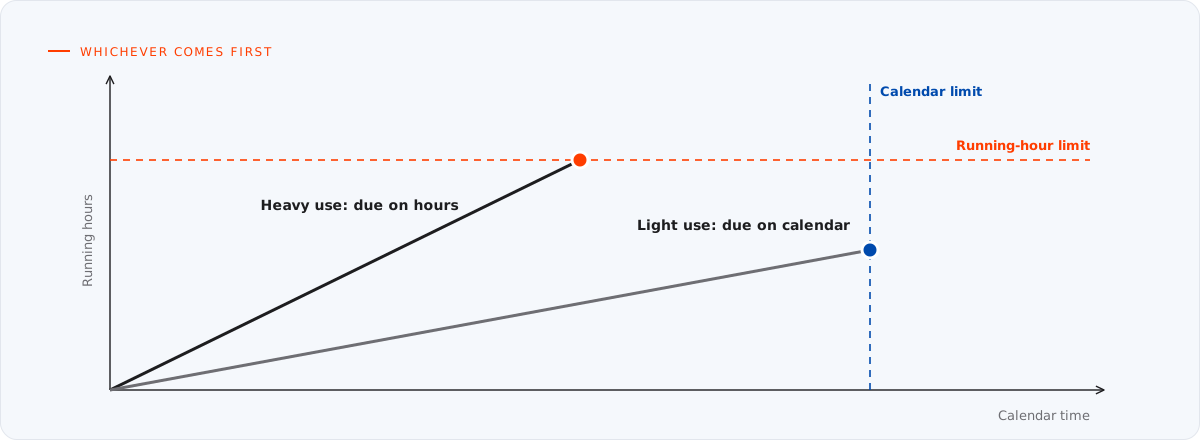
Figure 1. Whichever comes first: the same job falls due on hours for a heavily used machine and on calendar time for a lightly used one.
The rule for choosing between them is straightforward: use the basis the maker specifies for that model. Where the manual gives both, set both.
2. Counters make or break running-hour maintenance
A running-hour job is only as accurate as the counter that drives it. Most of the "mystery overdue" items we find in PMS databases trace back to counter problems:
- Shared counters. Several machines hang off one counter, so a job on a stand-by unit falls due because its duty partner has been running.
- Stale readings. Counters updated irregularly, so due dates jump when a backlog of hours is entered at once.
- Resets without history. A counter reset after an overhaul or a meter replacement, with no record of the old value, which breaks every job calculated from it.
Good practice is to give each machine its own counter, define who updates it and how often (monthly at least, more often for machinery with short intervals), and record meter changes as events rather than overwriting values.
3. Class: continuous survey and approved schemes
Classification societies survey machinery on a five-year cycle. Under a continuous machinery survey arrangement, the items are surveyed in rotation so that each one is examined within the cycle, rather than all at once at the renewal survey.
Many class societies also approve a ship's planned maintenance arrangements, so that maintenance carried out and recorded on board under that arrangement can be credited towards continuous survey items, subject to the society's conditions and periodic audit by a surveyor. The details differ between societies, so the owner's own class rules are the reference.
For the PMS, this has two consequences:
- Class items must be identifiable. Jobs that correspond to continuous survey items should be marked as such, so the ship and the office can see survey status directly from the maintenance schedule.
- Intervals must not drift past class limits. Where the maker's interval is longer than the survey cycle allows, the survey requirement governs, and the job library should say so.
4. Critical equipment and stand-by testing
The ISM Code asks companies to identify equipment whose sudden failure could cause a hazardous situation, and to take specific measures to keep it reliable, including regular testing of stand-by arrangements and of systems not in continuous use.
In interval terms, that usually means short calendar-based test jobs (start-up and changeover of stand-by pumps, emergency generator running, steering gear tests) alongside the maker's longer overhaul intervals. These tests are easy to under-record because they are quick, yet they are among the first things an inspector checks.
5. Postponements and deviations
Ships cannot always do a job on its due date: the vessel is trading, spares have not arrived, or the work needs a yard. A sound PMS treats a postponement as a decision with an owner, not as a quiet edit of the due date. That means:
- a reason recorded against the job;
- approval at the right level, which for critical equipment and class items normally means the office;
- a new due date or running-hour limit, not an open-ended deferral;
- any extra precautions or monitoring while the job is outstanding.
The ISM Code expects non-conformities to be reported, corrective action taken and records kept. A clean audit trail of postponements is how a PMS meets that expectation.
6. What auditors and inspectors look for
Internal audits, class surveys, port state control and vetting inspections (for example OCIMF's SIRE 2.0 for tankers) all test the same thing from different angles: does the maintenance record match reality? Typical checks include:
- Overdue list: how long it is, how old the items are, and whether critical equipment is on it.
- History consistency: completed jobs with sensible dates, hours and remarks, rather than batches closed on the same day.
- Counter plausibility: running hours that agree with the engine log and the vessel's trading pattern.
- Spares consumption: parts used that match the jobs recorded as done.
- Postponement records: reasons, approvals and new limits on file.
- Equipment match: the register describes the machinery actually fitted.
A database built on accurate intervals and disciplined counters passes these checks without special preparation, because the records are a by-product of doing the work.
7. When to change an interval
Intervals should not be frozen, but changes need a reason and a record. Legitimate triggers include:
- a maker's service letter or manual revision;
- condition-monitoring results, such as oil analysis, vibration or performance trends, supporting a longer or shorter interval;
- repeated findings at overhaul showing the equipment is in better or worse condition than the interval assumes;
- a change in the equipment's duty, for example a stand-by unit moved to continuous service.
Any change to a class or critical-equipment job should go through the company's management-of-change process and, where it touches class requirements, be agreed with the society.
Conclusion
Accurate intervals, one counter per machine, clearly marked class and critical items, and postponements handled as approved decisions: none of this is complicated, but together it separates a PMS that produces trustworthy evidence from one that produces noise.
References and further reading
- International Maritime Organization, International Safety Management (ISM) Code, section 10: Maintenance of the ship and equipment.
- The rules of the vessel's classification society for continuous survey of machinery and for approval of planned maintenance arrangements. Requirements differ between societies.
- Oil Companies International Marine Forum (OCIMF), Ship Inspection Report Programme (SIRE 2.0).
- Companion papers: From instruction book to job library and Migrating PMS data between systems.
Want your PMS intervals reviewed? We check job libraries against the makers' manuals and class requirements and correct the data for import. See our Planned Maintenance System services.